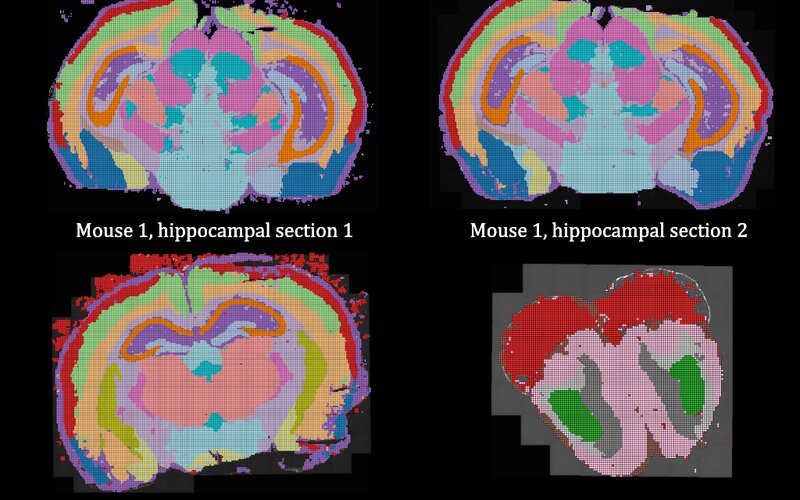
The compartments of the mouse brain are mostly outlined by hand, from tissue and cell morphology and reference atlases. This is hard, because sections are rarely parallel to the atlas sections, and organs vary in size and shape. Here, in situ sequencing data, dimensionality reduction and unsupervised clustering identify spatial compartments that match known anatomical compartments of the brain, on four sections.
Open the mouse brain in TissUUmaps 3.
Publication: G. Partel, M. M. Hilscher, G. Milli, L. Solorzano, A. H. Klemm, M. Nilsson and C. Wählby. Automated identification of the mouse brain's spatial compartments from in situ sequencing data. BMC Biology, 2020. doi:10.1186/s12915-020-00874-5
The raw in situ sequencing data was published in X. Qian, K. D. Harris, T. Hauling et al. Probabilistic cell typing enables fine mapping of closely related cell types in situ. Nature Methods, 17(1), 101–106, 2020. doi:10.1038/s41592-019-0631-4
The pipelines, data and software are available on Zenodo and GitHub.